Settle & Conquer: Best Catan Tactics
To win Settlers of Catan, players must focus on initial settlement placement, resource probability, and maintaining a clear path toward ten victory points. Success is typically achieved by securing a balance of 'brick and wood' for early expansion or 'ore and wheat' for a late-game city and development card strategy. In practice, seasoned players prioritize high-probability hexes (6s and 8s) and ensure access to at least three different resource types to maintain trading leverage.
Understanding Catan Tactics and Strategy
Settlers of Catan is a game of resource management and strategic positioning where the winner is the first to reach 10 victory points. Unlike many board games that rely solely on luck, Catan requires a deep understanding of board topology, probability distributions, and social negotiation. Winning strategies typically involve diversifying resource income, blocking opponents' expansion routes, and timing the transition from early-game building to late-game city upgrading.
Why Probability Drives Winning Percentage
The most important tactic in Catan is calculating the statistical likelihood of resource production based on the pips (dots) on each number token. A '6' or an '8' has five dots, representing a 13.89% chance of being rolled, while a '2' or '12' has only one dot (2.78%). Experienced players use the 'Red Number Rule,' ensuring at least one of their starting settlements sits on a 6 or 8 to maximize the frequency of resource accumulation.
The Importance of Resource Synergy
Resources in Catan work in pairs: Wood and Brick are required for Roads and Settlements, while Ore and Wheat are essential for Cities and Development Cards. A common mistake is specializing in only one resource without a path to acquire its counterpart. A 'balanced build' strategy targets a versatile resource mix to minimize reliance on the 4:1 bank trade, which is statistically inefficient unless a 2:1 harbor is secured early.
📊 Resource Distribution Effectiveness (Win Rate Impact)
Master the Initial Settlement Phase
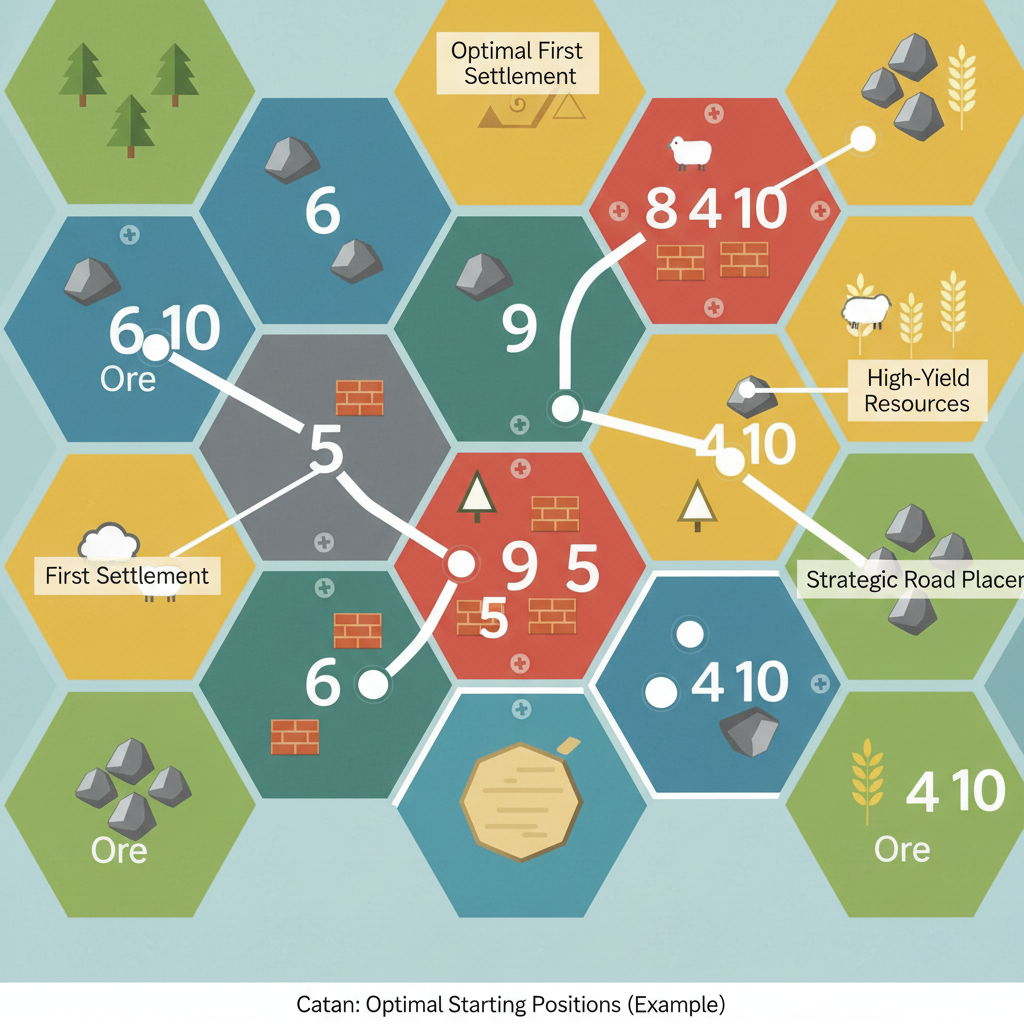
Initial settlement placement is the single most influential factor in determining the outcome of a Catan match, accounting for approximately 60-70% of a player's winning potential. Placement should be dictated by the 'Scarcity Principle,' where players identify which resource is most limited on the board and attempt to monopolize or secure strong access to it.
Identifying the Scarcity Factor
In every game, one resource is usually rarer than others due to the board layout. If there is only one high-yield Brick hex (like an 8 or 9), controlling that spot gives you immense trading power. By denying others access to a scarce resource, you force them into unfavorable trades, effectively slowing their progress while accelerating your own.
The 'Longest Road' vs. 'Largest Army' Path
Choosing between the Longest Road and Largest Army early in the game helps define your resource needs.
Longest Road: Requires high Wood and Brick production. Best for boards with open space and high-yield forest/hills.
Largest Army: Requires Ore, Wheat, and Sheep (for Development Cards). Best for tight boards where expansion is blocked.
Advanced Mid-Game Maneuvers
Once the board becomes crowded, players must pivot from expansion to optimization. This phase is characterized by the 'City Transition,' where players upgrade existing settlements to double their resource output. Based on real-world competitive play, upgrading a settlement on a high-probability hex (6, 8, 9, or 5) to a City is more valuable than building a new settlement on low-probability intersections (2, 12, or 3).
Utilizing the Trading Post (Harbors)
Harbors are the 'safety valve' of Catan strategy. If you find yourself over-producing a specific resource, such as Sheep, securing the 2:1 Sheep Port is vital. This eliminates the 'Trade Embargo' effect, where other players refuse to trade with the leader. Having a port allows you to remain self-sufficient and convert excess materials into the specific victory-point-generating resources you need.
The Psychology of Trading and Table Talk
Catan is a social game. 'Table talk' is a valid tactic used to highlight one player's lead to the rest of the group, encouraging them to use the Robber against the frontrunner.
"The most successful Catan players aren't just master mathematicians; they are master negotiators who can convince the table that their move benefits everyone while secretly securing their own path to victory."
💡 Tip
Always keep your Development Cards face down. This creates 'hidden information' that makes opponents hesitant to steal from you, especially if they suspect you are holding a Knight card to retaliate.
Tactics for Securing the Win
The 'Final Push' involves reaching the final 2-3 victory points quickly to prevent opponents from reacting. Most wins are secured through a combination of Development Card victory points, the Largest Army bonus, or a surprise City upgrade.
The Development Card Strategy
Development Cards are often the most undervalued aspect of the game. They offer structural advantages (Road Building), resource bursts (Monopoly), or defense (Knights). In high-level play, players often buy Development Cards when they have 7 or 8 points to 'hide' their true score until they can win in a single turn.
🥧 Victory Point Sources in Winning Games
Summary of Key Takeaways
Priority 1: Focus on High-Probability Hexes (6, 8, 9, 5).
Priority 2: Secure a path to both 'Expansion' resources (Wood/Brick) and 'Development' resources (Ore/Wheat).
Priority 3: Identify the rarest resource on the board and prioritize placement on it.
Priority 4: Build towards a Harbor if you have a high-yield single resource.
Priority 5: Use Development Cards to protect your resources and hide your final point tally.
Sources
The Statistics of Catan Dice Rolls
```json
{
