
Master Catan: Top Winning Strategies
Settlers of Catan is a game of resource management and tactical positioning where the objective is to earn 10 Victory Points through a combination of settlements, cities, development cards, and special bonuses. Winning consistently requires a deep understanding of probability, strategic trading, and the ability to pivot your strategy based on the board’s unique tile distribution.
Quick Answer: How Do You Win at Catan?
Winning Catan requires balancing three core pillars: optimal initial placement on high-probability hexes (6, 8, 5, and 9), securing a functional "resource engine" (like the Ore-Wheat-Sheep synergy), and managing spatial expansion to prevent being boxed in. Experienced players prioritize acquiring Development Cards and City upgrades early to maximize point density before the board becomes overcrowded.
The Power of Probabilities and Initial Placement
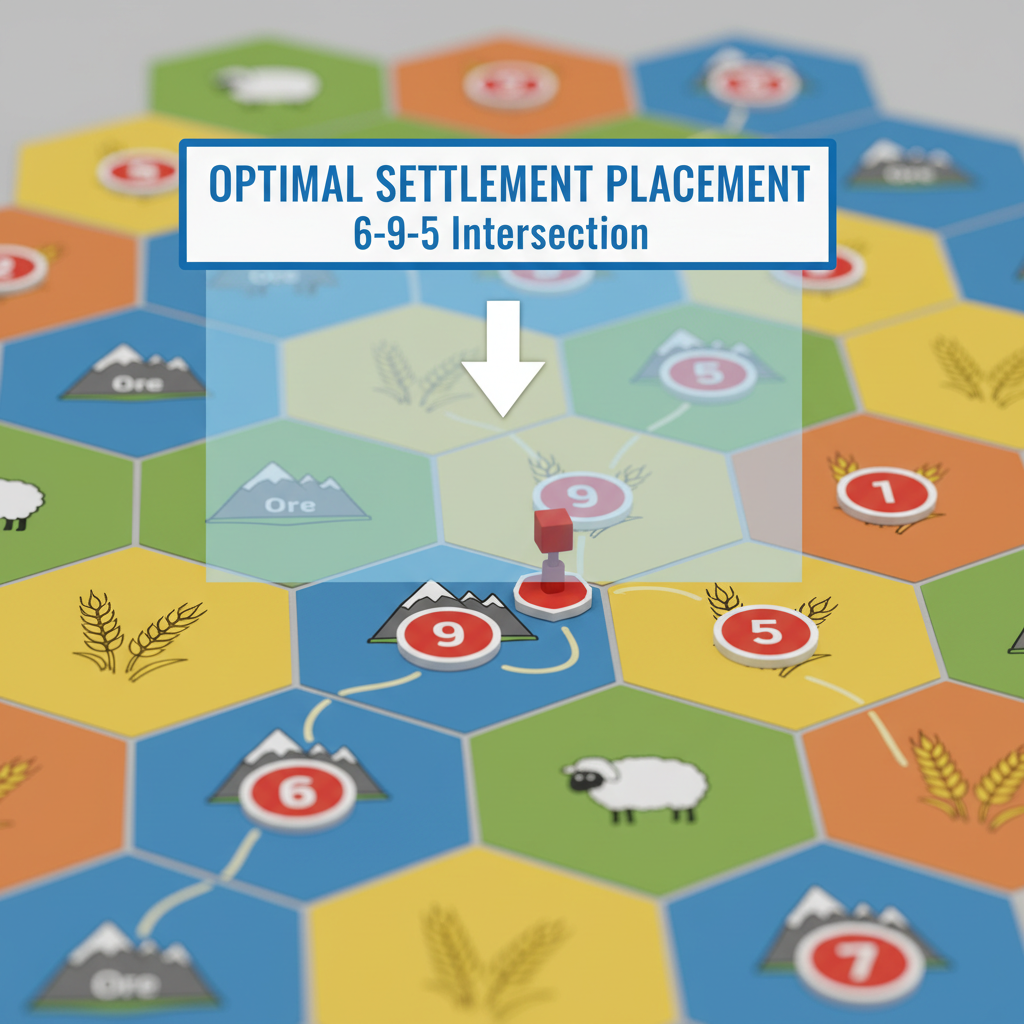
Initial placement is the most critical phase of Catan, often determining 60-70% of a player’s success. The primary goal is to maximize your "pips"—the dots on the number tokens representing the statistical frequency of that number being rolled on two six-sided dice.
How to Calculate Resource Income
In Catan, a 7 is the most common roll, while 6 and 8 are the next most frequent. By placing settlements on the intersection of three hexes, you calculate your total production potential by summing the pips of those tiles.
6 and 8: 5 pips each
5 and 9: 4 pips each
4 and 10: 3 pips each
3 and 11: 2 pips each
2 and 12: 1 pip each
In practice, a starting position with 12–15 total pips is considered a strong foundation for a winning game. Based on real-world results from competitive play, players who sacrifice a high-value number for a better diversity of resources often outperform those who over-rely on a single number that might "go cold" during the mid-game.
📈 Probability of Resource Yield by Dice Roll
Mastering the Two Primary Winning Archetypes
There are two dominant strategic frameworks in Catan: the ORE-WHEAT-SHEEP (OWS) strategy and the ROAD-EXPANSION (Brick/Lumber) strategy. Understanding which path the board layout supports is the hallmark of an expert player.
The Ore-Wheat-Sheep (OWS) Strategy
OWS is a "vertical" strategy that focuses on upgrading existing settlements into Cities and buying Development Cards. Because Cities double your resource output without requiring new land, this strategy is highly resistant to being "blocked" by opponents.
Efficiency: Buying Development Cards provides a path to Largest Army (2 VP) and hidden Victory Point cards.
Resilience: It requires less physical space on the board, making it ideal if you are starting in a corner or a crowded area.
The Road-Expansion Strategy
This "horizontal" strategy focuses on Brick and Lumber to build the Longest Road (2 VP) and secure high-value ports. This is a "wide" game that relies on securing more territory to diversify resource income. While visually dominant, it is often more vulnerable to the Robber and being cut off by savvy opponents.
"In high-level Catan tournaments, the OWS strategy typically has a higher win rate because it relies on fewer transactions and provides more flexible 'outs' through Development Cards."
💡 Tip
Always check for port synergy during the placement phase. If you have a high-production 6-ore, securing the 2:1 Ore Port can effectively replace the need for Wheat or Sheep through efficient trading with the bank.
The Economics of Trading and Social Play
Catan is as much a social game as it is a mathematical one. Effective trading is not just about getting what you need; it is about managing the "board state" to ensure no single player runs away with the lead.
When to Trade and When to Hold
Expert players follow the "Rule of 4": if you have four cards in hand and no way to spend them, you should trade aggressively to avoid losing half your hand to a 7 roll. However, trading with the current leader is a common mistake that allows them to reach 10 points faster.
The '2-for-1' Philosophy: In the early game, trading a 1:1 ratio is fine. In the late game, you should only trade if it directly results in a Victory Point or a critical settlement.
The Robber Strategy: Don't just place the Robber on the highest number; place it on the player who holds the most resources that you need, increasing your chances of stealing a specific card.
🥧 Average Points Sources in Winning Games
Summary of Key Takeaways
To master Catan, you must shift your mindset from simply gathering resources to optimizing your point-per-turn efficiency.
- 1 Prioritize Wood/Brick early for expansion, then pivot to Ore/Wheat mid-game for Cities.
- 2 Calculate pips before placing your first two settlements; aim for 12+ total pips.
- 3 Use ports to mitigate poor dice rolls and bypass uncooperative trading partners.
- 4 Buy Development Cards if you have excess Sheep and Wheat; they are the most undervalued path to victory.
Whether you are playing a friendly game at a local meetup or competing in a regional qualifier, remember that Catan is about adaptability. At Texas Table Top Games, we believe the best strategies are the ones that keep the game exciting and fun for everyone—right up until you reveal that final VP card for the win!
Sources
Official Catan Rulebook and Game Overview
BoardGameGeek: Catan Strategy Deep Dive
Probabilistic Analysis of Settlers of Catan
```json
{
