Catan Victory: Build Your Empire!
Settlers of Catan is a game of resource management, negotiation, and spatial strategy where the first player to reach 10 Victory Points wins. Mastering Catan requires a balance of statistical probability, adaptive expansion, and social engineering to outpace opponents on the hex-based island.
Quick Answer: Winning at Catan consistently requires focusing on high-probability resource hexes (6 and 8), securing a diverse portfolio of resources (specifically Ore, Wheat, and Sheep for a "City/Development Card" strategy), and managing the "social threat level" to avoid being blocked by the robber. Most games are won by players who prioritize building cities early to double their resource production before expanding into late-game settlements.
How do you choose the best starting settlements in Catan?
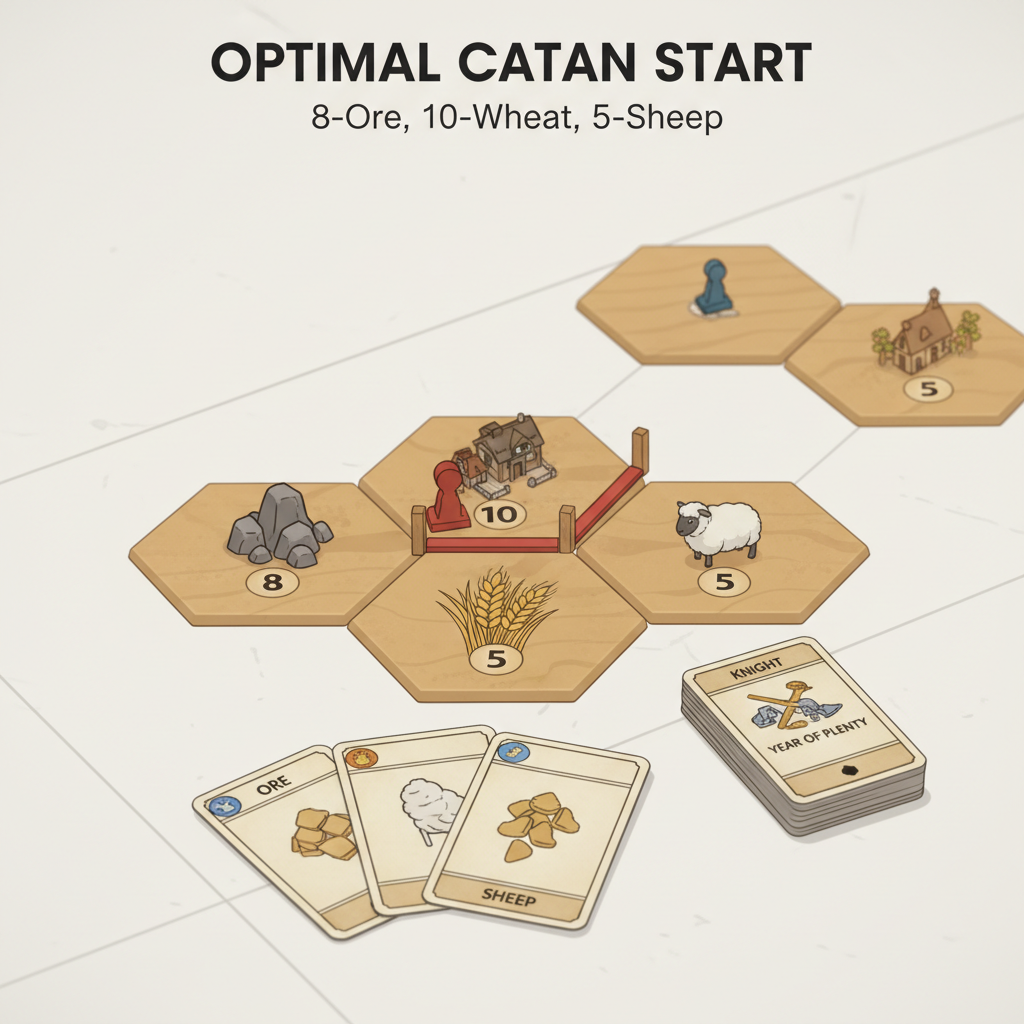
Starting placement is the single most influential factor in a Catan victory, often determining the trajectory of the first five turns. The primary goal is to maximize your Production Value (PV), which is calculated by the dots (pips) on the number tokens adjacent to your settlement. Historically, a starting position with 10–12 pips is considered strong, as it ensures a steady stream of resources regardless of specific rolls.
Why are the 6 and 8 hexes superior?
In Catan, the dice follow a Gaussian distribution (bell curve). The number 7 is the most frequent roll (16.6% chance), followed by 6 and 8 (13.9% each). Positioning your first two settlements on a combination of 6s and 8s maximizes your mathematical frequency of income. However, raw probability isn't everything; you must also ensure resource diversity. A player with three 8-tokens but only one resource type will suffer from "bottlenecking," where they have plenty of cards but cannot execute a build action without trading at a loss.
What role does the "Ore-Wheat-Sheep" strategy play?
In high-level competitive play, the "OWS" (Ore-Wheat-Sheep) strategy is often more effective than the "Wood-Brick" expansion strategy. By focusing on the resources required for Cities and Development Cards, players can win with fewer settlements. This strategy minimizes the need for long roads, which are vulnerable to being cut off, and maximizes the use of the Largest Army bonus (2 VP). Based on real-world tournament results, OWS players often have a higher win rate in 4-player games where board space is tight.
What are the most effective expansion strategies?
Expansion in Catan is the process of building roads to reach new coastal or inland intersections to increase resource variety and volume. An effective expansion strategy focuses on reaching a "port" that matches your highest-producing resource or securing the "Longest Road" only when it provides the final 2 points needed for victory.
How do ports influence your win rate?
Specialized 2:1 ports are game-changers because they eliminate your dependency on the other players' willingness to trade. If you have a settlement on an 8-Brick and a brick port, you effectively turn your brick into a "wild card" resource. In practice, securing a port by mid-game reduces the impact of the "Hand Limit" rule (discarding half your cards on a 7) because you can efficiently spend resources on your own turn.
📈 Average Win Rate Based on Resource Port Control
When should you compete for Longest Road?
Longest Road is often a trap. While it provides 2 Victory Points, it requires a heavy investment in Wood and Brick and makes you a target for the robber. A common scenario we encounter at Texas Table Top Games is a player building a 7-segment road early, only to have their expansion blocked by a single well-placed enemy settlement. Usually, it is best to aim for Longest Road only in the final stages of the game to jump from 8 to 10 points unexpectedly.
How to manage the social and trading meta-game
Catan is as much a social game as it is a mathematical one. Negotiation and the "Robber" mechanism allow players to handicap the leader. To win, you must manage your "table presence" so that you aren't perceived as the threat until it is too late for your opponents to stop you.
How do you trade efficiently without helping opponents?
Effective trading follows the "Net Gain Rule": never trade a resource if it allows an opponent to build a settlement or city that will outproduce yours. Be wary of "4-for-1" trades with the bank when a slightly better "2-for-1" or "3-for-1" might be available with a trailing player. In the mid-game, it is often wise to trade with the player in 3rd or 4th place to keep the 1st place player from pulling too far ahead.
💡 Tip
Always keep one "hidden" Victory Point from a Development Card if possible. Showing 9 points on the board makes you the permanent target of the robber, whereas showing 7 points (with 2 hidden) allows you to fly under the radar until your final turn.
How should you use the Knight cards and the Robber?
Based on defensive playstyles, the Robber should be used primarily to shut down the resource an opponent needs most, rather than just the highest-probability hex. If a player needs one more Ore for a City, placing the robber on their only Ore hex is more devastating than placing it on their 6-Wheat. Furthermore, holding a Knight card provides "Development Card Tempo," allowing you to move the robber off your own hexes instantly during your turn.
🥧 Distribution of Victory Points in Winning Games
Key Takeaways for Catan Success
Prioritize Probability: Always favor the 6s and 8s for consistent resource flow.
Cities Over Settlements: Doubling your production on a high-value hex is often better than building a new settlement on a low-value hex (like a 2 or 12).
Diversify Early: Aim to have access to all five resources by your third settlement to minimize trading reliance.
The Power of Dev Cards: Development cards provide versatility through Knights, Year of Plenty, and Road Building, which can circumvent bad dice rolls.
Winning at Catan isn't just about luck; it's about making the most statistically sound decisions and adapting to the board's unique layout. Whether you're playing a casual game at home or competing in a local tournament at Texas Table Top Games, these strategies will help you build your empire and claim the title of Lord of Catan.
