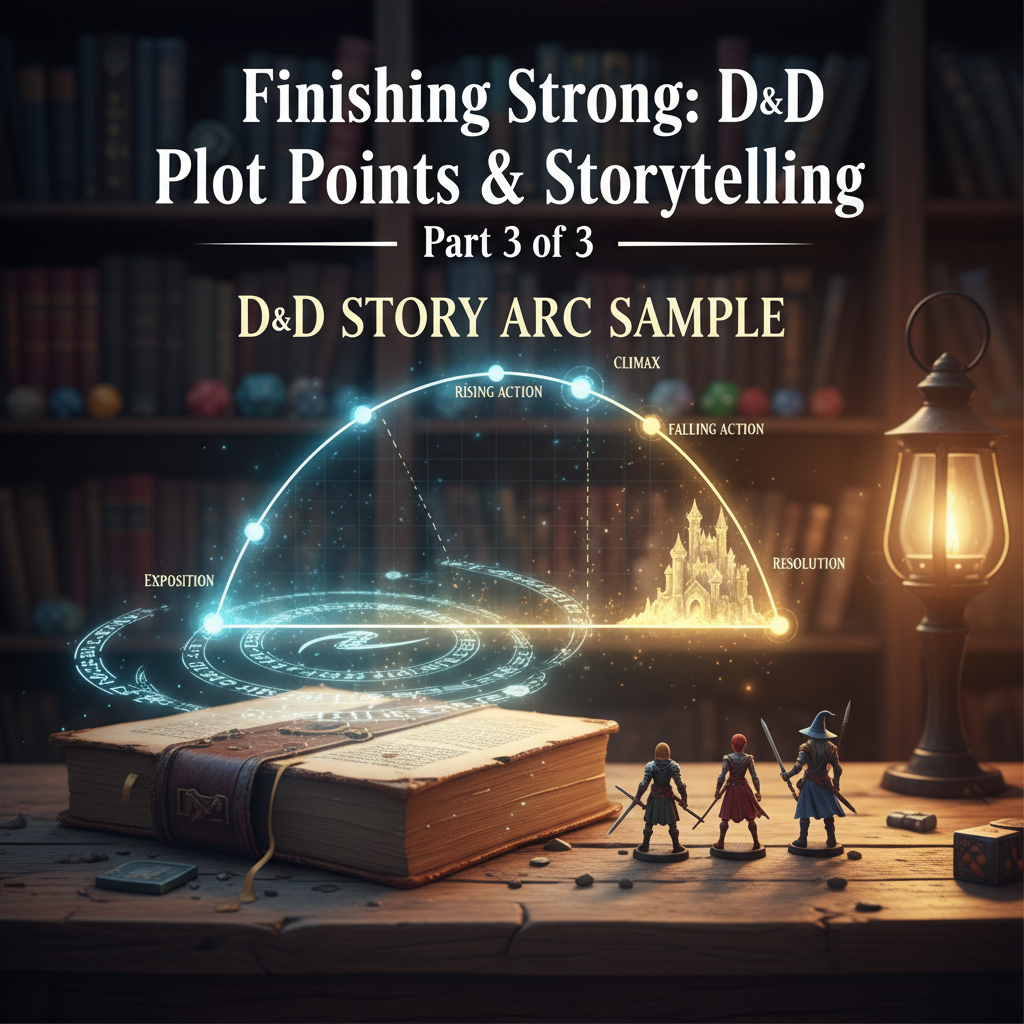
Dungeons and Dragon Story Sample standard story arc
A compelling Dungeons & Dragons climax requires the convergence of character arcs, unresolved tension, and high-stakes mechanical challenges. To finish a campaign strong, Dungeon Masters must transition from the 'Rising Action' to a 'Resolution' that rewards player agency and provides emotional closure to the narrative threads established in earlier sessions.
Quick Answer: How do you master the D&D campaign climax?
A successful D&D climax is achieved by resolving the primary conflict through a three-stage process: the Point of No Return (the final choice), the Climax (the mechanical and narrative peak), and the Resolution (the epilogue). By applying a classic D&D narrative structure, DMs can ensure that every major plot point feels earned and that the finale reflects the players' specific impact on the world.
This article serves as Part 3 of our series on the Dungeons and Dragon Story Sample standard story arc. Throughout this series, we explore how to take a campaign from a simple hook to a legendary conclusion. In this final installment, we focus on the art of the ending—ensuring your players leave the table with memories that last a lifetime.
Why is the Climax the Most Critical D&D Story Structure Example?
The climax of a TTRPG campaign is the moment where theory meets practice. It is the final test of the d&d story arc template, where the heroes’ growth is measured against the ultimate antagonist or obstacle. Unlike a movie, a D&D ending is collaborative, meaning the DM must provide the framework while allowing the players to provide the resolution.
The Mechanics of Stakes and Tension
In professional game design, tension is often tracked by the exhaustion of resources. According to common D&D encounter design benchmarks, a finale should utilize 'Deadly' encounter math to force players to use the unique abilities they have gained throughout the campaign. Research into player engagement suggests that the most memorable sessions are those where the risk of failure is palpable but the path to victory remains visible through creative play.
Managing Multiple Narrative Threads
By the end of a long-term campaign, a DM often has 5-10 minor subplots alongside the main "save the world" narrative. A sophisticated fantasy storytelling framework for dms involves "braiding" These threads. For example, if a Rogue is seeking revenge and the Bard wants to clear their family name, the final battle should take place in a location or against a foe that addresses both needs simultaneously.
📈 Player Retention and Satisfaction by Campaign Phase
Essential Dungeons and Dragons Adventure Plot Points for the Finale
The finale is not just a single boss fight; it is a sequence of dungeons and dragons adventure plot points that build momentum. Based on real-world DMing experience at Texas Table Top Games, we find that the most satisfying endings follow a rhythmic structure of tension and release.
The Point of No Return
This is the definitive moment where the party commits to the final objective. In a ttrpg campaign writing guide, this is often called the "Threshold." It serves two purposes: it signals to the players that the end is near, and it prevents the narrative from sprawling further. This usually involves a physical barrier (the gate to the Abyss) or a temporal one (the countdown to the ritual).
The Final Confrontation and Twist
A great finale often includes a revelation that recontextualizes the heroes' journey. However, avoid the "It was all a dream" trope. Instead, use a twist that heightures the emotional weight. Perhaps the villain is a fallen hero the party once admired, or the artifact they sought to destroy is the only thing keeping a worse evil at bay.
💡 Tip
Use a "Boss Phase" mechanic to keep the final fight dynamic. When the boss reaches 50% HP, change the environment or the boss’s attack patterns to signal the transition into the narrative peak.
How to Craft a Meaningful Epilogue
The epilogue is the often-overlooked final stage of the classic d&d narrative structure. It is the space where players see the long-term consequences of their actions. Without a proper epilogue, a campaign can feel abrupt and unfinished.
Defining the "New Normal"
Based on our experience, a 30-to-60 minute non-combat session dedicated to the aftermath typically yields a much higher satisfaction rate than ending immediately after the boss dies. Each player should be given a "focus moment" to describe where their character goes next. Do they retire to an orchard? Do they become the new King? Establishing this "new normal" provides the definitive closure required for a successful transition to the next campaign.
"A campaign is a promise you make to your players; the ending is the fulfillment of that promise. If the journey was about growth, the ending must show the character's full bloom."
🥧 The Three Pillars of a Strong Finale
Summary of Key Takeaways
- Resource Management: Ensure the climax is a mechanical test that uses the full breadth of the characters' levels.
- Closure over Cliffhangers: While small hooks for future games are fine, the primary conflict must reach a definitive conclusion.
- Player Agency: The victory must feel like it was achieved because of the players' specific choices, not because the DM's script demanded it.
By following this dungeons and dragons campaign ideas framework, you ensure your players walk away from the table feeling like true heroes of their own story.
Sources
- 1Dungeon Master’s Guide (Official D&D Source)
- 2The Alexandrian: Node-Based Scenario Design
- 3Sly Flourish: The Lazy Dungeon Master
