Beyond the Bets: Mastering Poker Strategy - Part 2 of 3
Understanding poker strategy requires moving beyond the simple mechanics of betting to master the psychological and mathematical frameworks that govern the game. To achieve long-term profitability, players must implement a structured approach that prioritizes position, hand selection, and the ability to read opponents' betting patterns. This second installment of our "Poker For Beginners" series bridges the gap between basic rules and the strategic depth needed to compete in Texas Hold'em and other variations.
Quick Answer: What is Advanced Poker Strategy?
Poker strategy is the systematic application of mathematical probability, psychological observation, and risk management to maximize the expected value (EV) of every hand. Successful players shift their focus from "trying to win every pot" to making decisions that yield the highest statistical return over thousands of hands. This involves tight-aggressive (TAG) play, understanding range construction, and leveraging table position to gain information before acting.
Why Position is the Most Important Tool in Poker
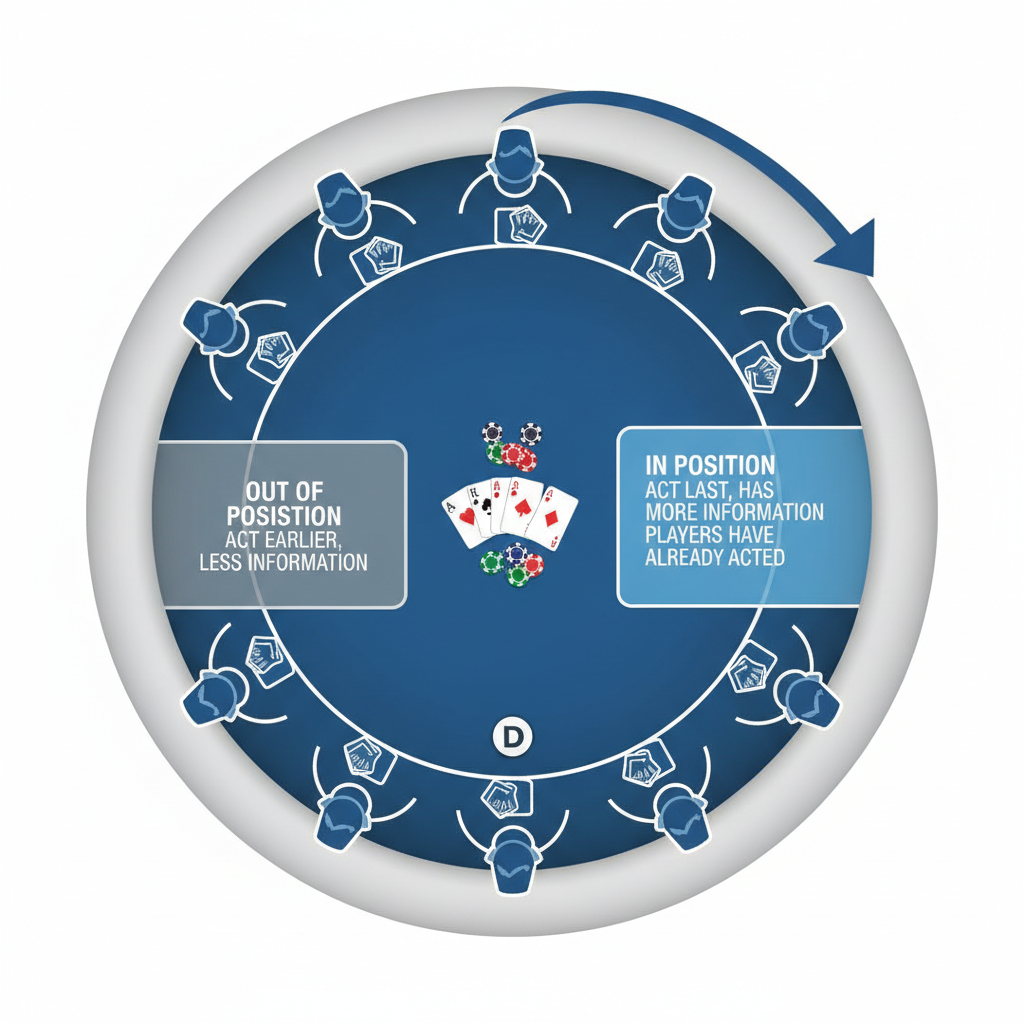
In poker, position refers to the order in which players act during a betting round; playing "in position" means acting last. This is the single greatest advantage a player can have because it provides the maximum amount of information before you are forced to commit chips to the pot. When you act last, you have observed the strength—or perceived weakness—of every other player at the table.
The Advantage of the "Button"
The Button (dealer position) is the most profitable seat at the table because you act last in every post-flop betting round. According to industry benchmarks, players typically realize a significantly higher win rate from the Button than from the Small Blind or Early Position. Being last allows you to "pot control" (keep the pot small with mediocre hands) or apply pressure through "bluffing" when your opponents show weakness by checking.
Navigating Early vs. Late Position
Early position (the seats immediately to the left of the blinds) requires a "tighter" range, meaning you should only play premium hands like pocket Aces (A-A) or Kings (K-K). Conversely, in late position, you can "open" or raise with a wider variety of hands because the risk of being re-raised by someone behind you is lower.
📊 Win Rate Distribution by Table Position
Understanding Pot Odds and Expected Value (EV)
Pot odds represent the ratio between the size of the pot and the size of the bet you are facing. To make a mathematically correct call, your "equity" (chance of winning the hand) must be higher than the price the pot is offering you. This is the foundation of "Expected Value," a concept used to determine if a play will make or lose money in the long run.
Calculating Your Outs and Equity
"Outs" are the cards left in the deck that will improve your hand to the winner. For example, if you have four cards to a flush, you have 9 outs (13 total suit cards minus the 4 in your hand/on the board). A common shortcut used by pros is the "Rule of 2 and 4":
- 1Multiply your outs by 2 to find your percentage of hitting on the next card.
- 2Multiply your outs by 4 to find your percentage of hitting by the river.
Is the Call Profitable?
If the pot is $100 and your opponent bets $50, the total pot is now $150. You must call $50 to win $150 (3-to-1 odds). To break even, you need to win at least 25% of the time. If your calculated equity based on your outs is 35%, making the call is "+EV" (positive expected value), and you should proceed.
"In poker, the goal is not to win the most pots, but to make the most mathematically sound decisions. The money follows the logic, not the luck."
The Psychology of Table Image and Player Profiles
While math provides the skeleton of poker strategy, psychology provides the skin. Your "table image" is how other players perceive your playing style, and it dictates how they will react to your bets. Recognizing the different types of players is essential for tailoring your strategy to exploit their specific weaknesses.
Identifying Common Player Archetypes
At Texas Table Top Games, we often see four primary archetypes in casual and competitive play:
Tight-Passive (The Rock): Only plays premium hands and rarely bets or raises. You can easily bluff them off pots.
Loose-Passive (The Calling Station): Plays many hands and hates folding. Never bluff a calling station; only bet when you have a strong hand.
Loose-Aggressive (LAG): Plays many hands and bets frequently. They are dangerous but often overextend, making them targets for a well-timed trap.
Tight-Aggressive (TAG): The gold standard of play. They play few hands but play them strongly.
🥧 Average Hand Range % by Player Type
💡 Tip
Always track the "VPIP" (Voluntarily Put In Pot) of your opponents. If a player is entering more than 40% of hands, they are likely a "loose" player who you can exploit by waiting for a strong hand and betting for value.
Summary of Key Strategic Takeaways
Mastering poker strategy requires a transition from emotional play to logical analysis. Based on real-world outcomes at competitive tables, players who adhere to these three pillars see significant improvements in their win rates:
- 1 Selectivity: Only play hands that have a mathematical chance of winning based on your position.
- 2 Aggression: When you enter a pot, be the one betting and raising. This gives you two ways to win: by having the best hand or by forcing your opponent to fold.
- 3 Observance: Your opponent's physical and betting cues are data points. Treat every hand—even those you aren't in—as a learning opportunity.
In Part 3 of this series, we will take these strategic foundations and apply them to high-level tactics, including 3-betting ranges, check-raising on the flop, and the art of the multi-street bluff.
Sources
The Mathematics of Poker - Bill Chen
PokerGO News: Understanding Pot Odds
Upswing Poker: The Importance of Position
Two Plus Two Interactive - Poker Strategy Forums
