
Cracking Poker's Code: The Basics - Part 1 of 3
Texas Hold’em is a community card game where players aim to make the best five-card hand using two private hole cards and five shared cards on the board. The game is won either by having the highest-ranking hand at a showdown or by forcing all other players to fold through strategic betting. This foundational guide marks the beginning of our three-part series designed to transform novices into confident players by mastering the essential mechanics and rules of the game.
At Texas Table Top Games, we believe the thrill of poker comes from the perfect blend of luck and logic. In this first installment, we break down the mechanics of the game, hand rankings, and the flow of a standard hand. By the end of this series, you will have progressed from understanding simple blinds to navigating complex post-flop strategies.
What is the Basic Objective of Poker?
The primary goal of poker is to win the pot, which is the sum of money or chips wagered by players during a hand. A player wins the pot by either holding the highest-ranking hand at the conclusion of all betting rounds (the showdown) or by making a bet that no other player is willing to call. Success in poker relies on understanding mathematical probability and the psychology of betting.
In practice, many beginners mistake the goal of poker as "winning every hand." Real-world results show that professional players often fold 70-80% of their starting hands. The true objective is making high-value decisions that maximize profit on winning hands and minimize losses on losing ones.
The Standard Poker Hand Rankings
Hand rankings are the universal language of poker, determining who wins the pot at showdown. These rankings are based on the statistical rarity of specific card combinations.
- 1 Royal Flush: A, K, Q, J, 10 of the same suit.
- 2 Straight Flush: Five cards in sequence, all the same suit.
- 3 Four of a Kind: Four cards of the same rank.
- 4 Full House: Three of a kind combined with a pair.
- 5 Flush: Five cards of the same suit, not in sequence.
- 6 Straight: Five cards in sequence, different suits.
- 7 Three of a Kind: Three cards of the same rank.
- 8 Two Pair: Two different pairs.
- 9 One Pair: Two cards of the same rank.
- 10High Card: When no other hand is made, the highest card wins.
📊 Probability of Making Hands (Texas Hold'em)
How Does a Hand of Texas Hold’em Flow?
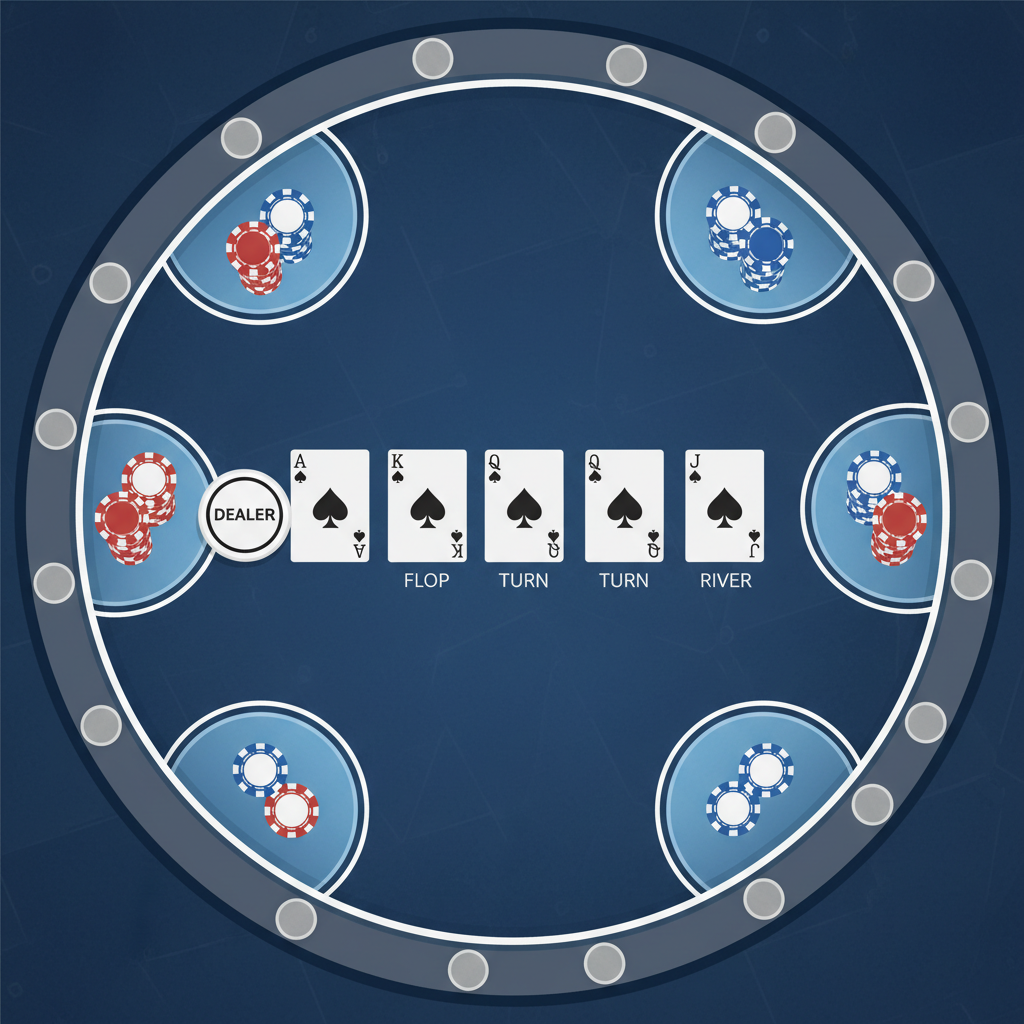
A standard poker hand follows a structured sequence of four betting rounds: the Pre-flop, Flop, Turn, and River. The action begins with two forced bets, known as the Small Blind and the Big Blind, which ensure there is a prize to play for in every hand. Players then receive two private cards (hole cards) before the community cards are dealt.
The Four Betting Rounds
Each round offers players the opportunity to Check (pass the action), Bet (put chips in), Call (match a bet), Raise (increase a bet), or Fold (give up the hand).
The Pre-flop: Players act based only on their two private cards.
The Flop: Three community cards are dealt face-up. This is where most hands take shape.
The Turn: A fourth community card is dealt. The complexity of the game increases as the pot grows.
The River: The fifth and final community card is dealt. This is the last chance for betting.
💡 Tip
Always pay attention to the "Dealer Button." The player with the button acts last in most rounds, providing a massive informational advantage because they see what everyone else does before making a decision.
Understanding Table Positions and Their Importance
Table position refers to where a player sits relative to the dealer button, and it is arguably the most critical factor in winning poker strategy. "In position" means you are the last to act, while "out of position" means you must act early. Position dictates how wide or narrow your range of playable hands should be.
Based on real-world results, players in the "Button" or "Cutoff" (late positions) consistently maintain higher win rates than those in the "Under the Gun" (early position) spots. This is because acting last allows you to gather information on the strength of your opponents' hands based on their checks or bets.
📈 Win Rate Advantage by Position
"In poker, cards are just the tools; position is your real leverage. Playing the same hand from the Button versus Under the Gun changes your win probability significantly."
Common Pitfalls for New Players
One of the most frequent mistakes beginners make is "overvaluing" any two cards simply because they are suited or connected. According to the Wizard of Odds, the mathematical likelihood of improving a mediocre starting hand into a winning one is often much lower than beginners perceive.
Another misconception is that bluffing is the core of the game. In practice, successful low-stakes poker is often "ABC Poker"—playing strong hands aggressively and folding weak ones. Over-bluffing typically leads to a 20-40% faster depletion of a bankroll for novice players compared to a disciplined, tight-aggressive approach.
Summary of Poker Foundations
Cracking the code of poker begins with mastering these three pillars:
- 1Hand Rankings: Knowing exactly which combinations beat others.
- 2Game Flow: Navigating the four betting rounds with discipline.
- 3Positional Awareness: Understanding that where you sit is as important as what you hold.
At Texas Table Top Games, we’ve seen that the players who take the time to learn these basics are the ones who have the most fun and stay in the game the longest. Poker isn't just a game of cards; it's a game of people played with cards, and it starts with the rules.
In Part 2, we'll explore the mental shift from just knowing the rules to actually making money, focusing on betting sizes and starting hand selection. Continue reading: Beyond the Bets: Mastering Poker Strategy - Part 2 of 3
Sources
Official Poker Rankings & Rules
The Mathematics of Poker - Carnegie Mellon University
Poker Strategy and Position Guide
Read the Full Series
Cracking Poker's Code: The Basics - Part 1 of 3
Beyond the Bets: Mastering Poker Strategy - Part 2 of 3
