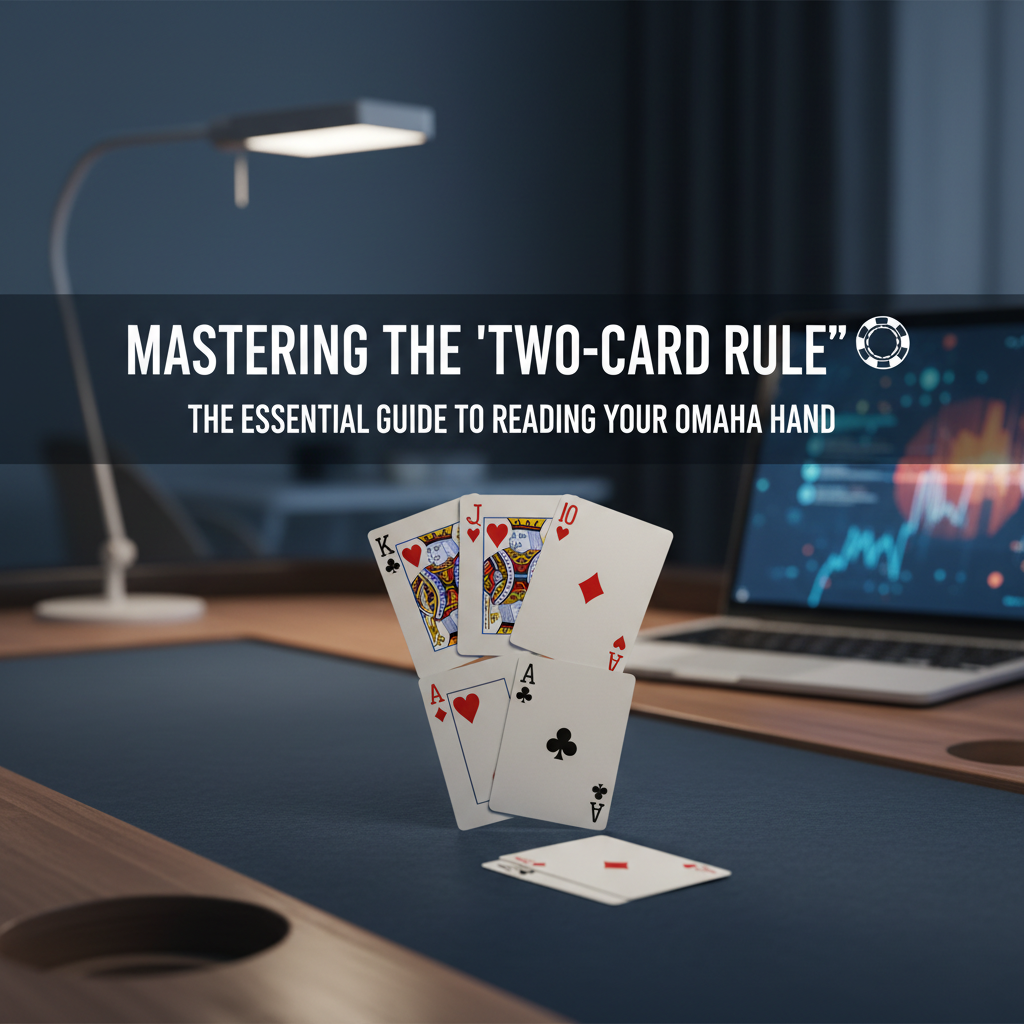
Mastering the 'Two-Card Rule': The Essential Guide to Reading Your Omaha Hand
In the world of poker, Pot Limit Omaha (PLO) is often described as a game of "great action," but for those transitioning from Texas Hold'em, it is also a game of great confusion. The fundamental difference lies in how you construct your final five-card hand, specifically governed by the strict "Two-Card Rule." At Texas Table Top Games, we believe that mastering this mechanic is the single most important step in moving from a beginner to a confident player.
Quick Answer: How do you read an Omaha hand?
To read an Omaha hand correctly, you must use exactly two cards from your four-hole-card hand and exactly three cards from the five community cards (the board). Unlike Texas Hold'em, where you can use one, two, or even zero cards from your hand, Omaha offers no such flexibility; the 2-and-3 combination is mandatory for every legal hand ranking.
Why is the Two-Card Rule the most important Omaha hand rule for beginners?
The Two-Card Rule is the defining mechanic of Pot Limit Omaha that dictates every strategic decision from pre-flop to showdown. In Texas Hold'em, players are accustomed to "playing the board" (using five community cards) or using a single hole card to complete a flush or straight. In Omaha, these plays are impossible.
Common Misconceptions for Beginners
A frequent pitfall occurs when a player holds the Ace of Spades in their hand and there are four Spades on the board. In Hold'em, that player has a flush. In Omaha, unless that player holds a second Spade in their hand, they do not have a flush. They only have "high card Ace" or whatever other pair they can form using two cards from their hand.
Is Omaha Poker for beginners harder than Hold'em?
While the betting structures are similar, Omaha is mathematically more complex because each player is dealt four cards, creating six possible two-card combinations. This leads to much stronger average winning hands.
📈 Winning Hand Frequencies: PLO vs. NLHE (Estimated)

How do you accurately read Omaha hands during gameplay?
Accurately reading an Omaha hand requires a mental shift to view your four hole cards as six distinct two-card hands. To determine your best hand, you must evaluate each of these six pairs against the three-card combinations available on the board.
Step-by-Step Hand Construction
- 1 Identify your six pairs: If you hold A-K-Q-J, your pairs are AK, AQ, AJ, KQ, KJ, and QJ.
- 2 Evaluate the board: Look at the five community cards and identify potential three-card clusters (e.g., three cards of the same suit or three cards in a sequence).
- 3 Apply the 2+3 requirement: Select the two cards from your hand that best complement the three cards on the board.
How do "Wraps" affecting hand reading?
In Omaha, you will often encounter "wraps," which are straight draws with significantly more outs than in Hold'em. Because you have four cards, you can "wrap around" the board texture. For example, if the board is 7-8-x and you hold 5-6-9-10, you have a massive number of cards that can complete your straight.
ℹ️ Info
Pro Tip: Always double-check your "trips." If you hold K-K-K-2 and the board comes K-7-3, you do NOT have four-of-a-kind. Since you must use exactly two cards from your hand, you actually have three-of-a-kind (K-K from your hand and the K from the board).
What are the specific Pot Limit Omaha hand rankings?
Pot Limit Omaha hand rankings follow the standard high-poker hierarchy (Royal Flush, Straight Flush, Four of a Kind, etc.), but the strength required to win a pot is significantly higher than in other variants.
The Hierarchy of Strength
In a typical $1/$2 PLO game, a "small" hand like one pair or two pair is rarely enough to win a large multi-way pot. Based on real-world results in Texas card rooms, hands frequently "over-set" each other, and "the nut" (the best possible hand) changes on every street.
Why "The Nuts" Matter More in Omaha
Because every player has six combinations, the likelihood of someone holding the best possible straight or flush is high. If there is a pair on the board, someone almost certainly has a Full House. This makes "drawing to the nuts"—striving to make a hand that cannot be beaten—the primary strategy for successful Omaha play.
📉 Projected Growth of Omaha Popularity in US Poker Rooms (2020-2026)
What are common pitfalls to avoid when reading your hand?
The most dangerous mistake is "visual bias"—seeing a hand that isn't legally there. This often happens with "Four-of-a-Kind" in the hole or "Four-to-a-Flush" on the board.
The "Four of a Kind" Trap
If you are dealt four Aces (A-A-A-A) in Omaha, it is actually a very poor hand. You can only use two of those Aces. This means you have a pair of Aces, but you have also "blocked" your own ability to hit an Ace on the board to make three-of-a-kind. You effectively have the lowest possible chance of improving your hand.
Mistakes with Board Pairs
When the board pairs (e.g., 9-9-5-3-2), a player holding an 9 in their hand often thinks they have trips. However, if they don't have a second card that pairs with the 5, 3, or 2, or another 9 in their hand (to make four-of-a-kind), their hand might be weaker than it looks.
"In Omaha, you aren't just playing your cards; you're playing the permutations. If you can't visualize your two-card requirements instantly, you're playing at a disadvantage." — Texas Table Top Games Expert
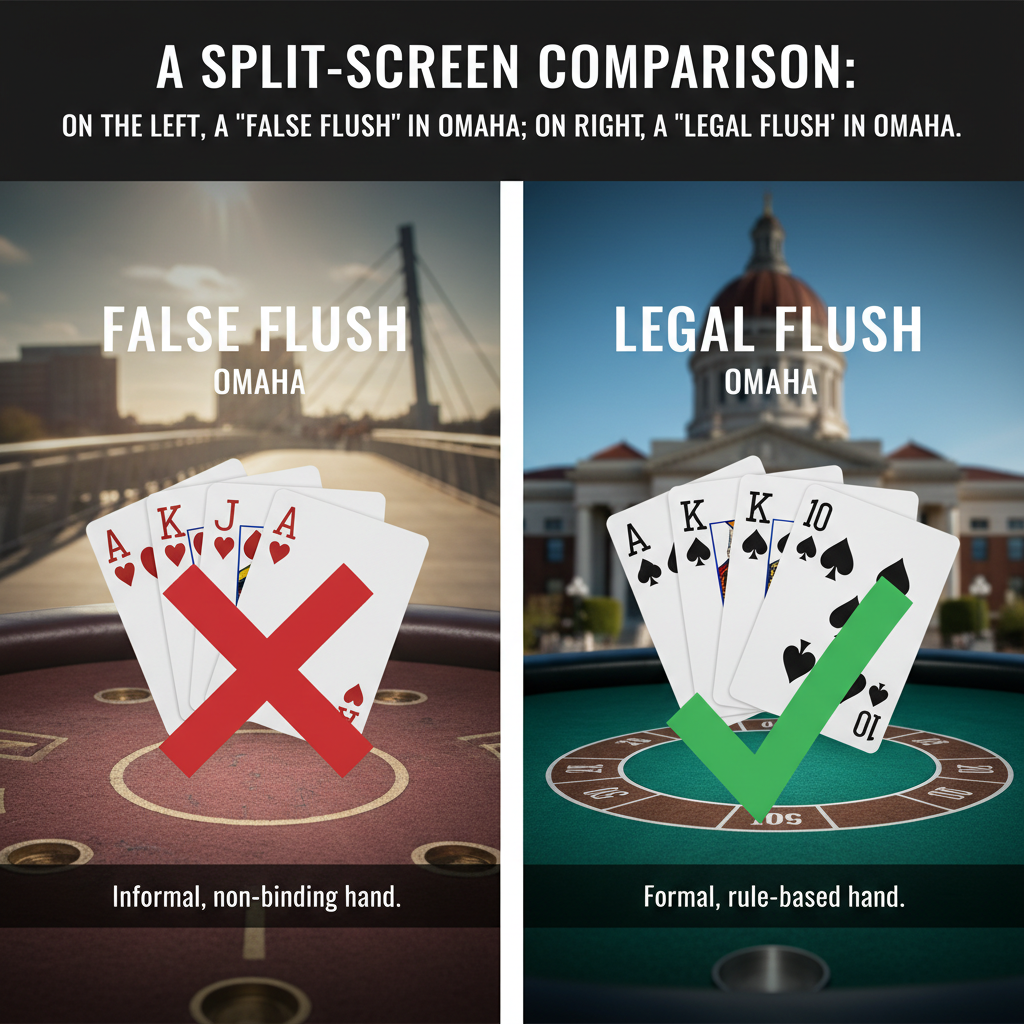
Summary: Key Takeaways for Mastering Omaha Hands
The 2/3 Rule is Absolute: You must use two cards from your hand and three from the board. No exceptions.
Hand Selection is Key: Hands like A-A-K-K double-suited are powerful because they offer multiple ways to form that "two-card" requirement.
Respect the Board Texture: If the board shows a pair or three of a suit, the "standard" winning hand strength increases dramatically.
Draw it Right: Ensure your draws are to the "nuts" so you don't find yourself with the second-best hand in a massive pot.
Sources
- 1 MasterClass - Poker Rules: How to Play Omaha Poker
- 2 Upswing Poker - 4 PLO Mistakes to Avoid
- 3 PokerNews - Omaha Poker Rules
- 4 Wikipedia - Omaha Hold'em Strategy and Rules
