
From Pocket Aces to 7-2: The Ultimate Beginner’s Ranking of Poker Starting Hands
In the world of Texas Hold’em, your first and most important decision occurs before the flop is even dealt. Understanding starting hand rankings is the foundation of any successful Texas poker strategy, as it dictates whether you should invest your chips or wait for a better opportunity. Successful players don't play every hand; they wait for mathematical advantages that increase their long-term win rate.
What are the best starting hands in Texas Hold'em?
The best starting hands in Texas Hold’em are high-value pairs and strong "big card" combinations, often referred to as "Premium Hands." These hands have the highest statistical probability of winning at showdown without needing significant improvement from the community cards.
The "Big Three" Premium Pairs
Pocket Aces (AA), Pocket Kings (KK), and Pocket Queens (QQ) are the three strongest hands in the game. According to various equity calculators, Pocket Aces will win against a random hand approximately 85% of the time. These are "must-play" hands in almost every situation, regardless of your position at the table.
Ace-King Suited (The "Big Slick")
While not a made pair, Ace-King suited (AKs) is considered a top-tier starting hand because of its versatility. It can make the nut flush, the nut straight, or top pair with the best possible kicker. In tournament play, AKs often performs as well as middle-range pairs in "coin flip" scenarios.
Top-Tier Starting Hand Probabilities
To understand why these hands are ranked so highly, we must look at the frequency of being dealt these powerhouses and their raw equity.
🥧 Freq. of Being Dealt Specific Starting Hands
How are poker hands ranked for beginners?
Poker starting hands are generally categorized into "Tiers" based on their profitability and ease of play for newcomers. For beginners, a tighter strategy—playing fewer, stronger hands—is the most reliable way to preserve your bankroll while learning the nuances of the game.
Tier 1: The Premiums (AA, KK, QQ, JJ, AKs)
These hands are the gold standard. In a Texas card room, you will almost always see a "raise" or "re-raise" when a player holds these. They are strong enough to play from any position (Early, Middle, or Late).
Tier 2: Strong Starters (TT, AQs, AJs, KQs, AKo)
These hands are very strong but require more caution than Tier 1. For instance, Pocket Tens (TT) is a powerful hand but can be difficult to play if three overcards (like Queen, King, Ace) appear on the flop.
Tier 3: Speculative Hands (Medium Pairs, Suited Connectors)
Hands like Pocket Sevens (77) or 8-9 suited are "speculative" because they usually need to hit the flop hard (making a Three-of-a-Kind or a straight draw) to be profitable. Beginners should typically only play these from "Late Position" (near the Dealer button) where they have more information on their opponents' actions.
Why is 7-2 Offsuit considered the worst hand?
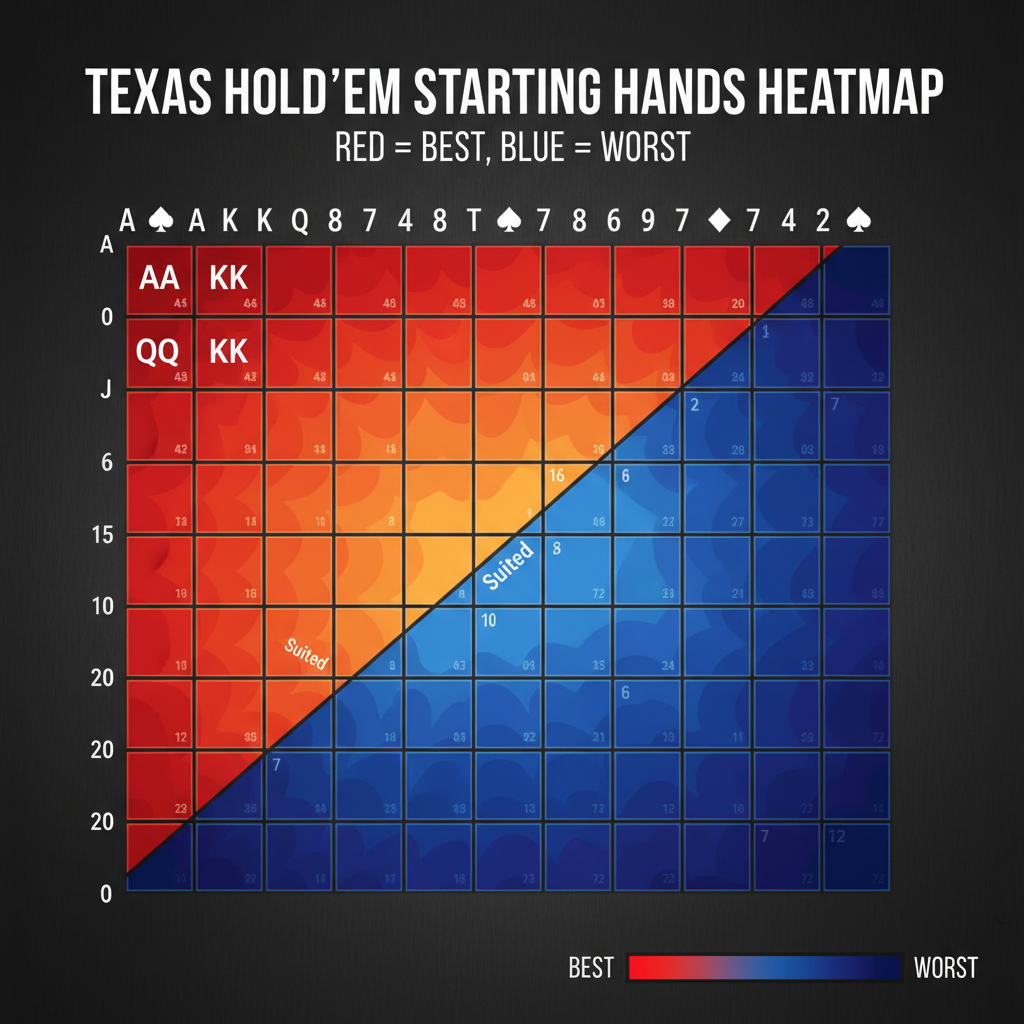
The hand 7-2 offsuit is mathematically the weakest starting hand because it has the lowest probability of forming a winning combination. It cannot make a straight using both cards (there are four gaps between 2 and 7), and because the cards are different suits, it cannot easily make a flush.
"In poker, your greatest asset isn't the chips in front of you; it's the discipline to fold the 7-2 offsuit when everyone else is gambling."
The "Trap" of Low Cards
Many beginners make the mistake of playing low cards because "they could hit a two-pair." However, even if you hit a pair of 7s with a 2 kicker, you are frequently "out-kicked" by anyone holding a 7 with a higher side card (like A-7 or K-7). This leads to significant chip losses that are easily avoidable.
How does table position affect hand rankings?
Position refers to where you sit in relation to the Dealer button, and it fundamentally changes the value of your beginner poker hands. In practice, a hand like King-Jack offsuit might be a "fold" in Early Position but a "raise" in Late Position.
The Power of the Button
When you are on the "Button" or in the "Cutoff" (the seat to the right of the button), you are the last to act on every round after the flop. This allows you to see how your opponents react before you have to commit chips. Because of this information advantage, you can profitably play a wider range of hands, including lower suited connectors and weaker Aces.
ℹ️ Info
Pro Tip: As a general rule for beginners, if you are one of the first three people to act (Under the Gun), only play the top 10% of hands. As you move closer to the button, you can expand that to the top 25%.
What is the proper Texas card room etiquette for new players?
Beyond knowing your hand rankings, participating in a live game requires following Texas card room etiquette to ensure a smooth and fun experience for everyone.
Act in Turn
The most important rule is to wait for the player to your right to act before you make your move. "Acting out of turn" gives players behind you unfair information and can disrupt the flow of the game.
One Player to a Hand
Even if you are playing with a friend, you cannot discuss your hand while the play is live. This maintains the integrity of the game. Similarly, don't show your folded cards to your neighbor until the hand is completely over.
Handling Your Chips and Cards
Keep your cards visible: Always keep your cards on the table, usually with a "card protector" (like a lucky coin) on top.
No "String Bets": When you bet, put all your chips into the pot in one motion or announce the amount clearly before moving them. Adding chips bit by bit is known as a string bet and is not allowed.
Summary of Hand Power
Understanding the breakdown of hand strength over a long-term sample helps players realize that poker is a game of patience rather than constant action.
📊 Est. Win Rates of Top Starting Hands vs. 9 Players
Key Takeaways
Quality over Quantity: Focus on playing the top 15-20% of hands to maintain a mathematical edge over "loose" players.
Respect Position: Your seat at the table is just as important as the cards in your hand. Play tighter in early positions and looser in late positions.
Avoid "Trash" Hands: There is no "lucky" 7-2. Mathematically, it is a long-term losing proposition.
Follow Etiquette: Good manners make you a welcome guest in any card room and keep the game entertaining for everyone.
Sources
PokerNews: Texas Hold'em Starting Hands Cheat Sheet
Upswing Poker: The Ultimate Guide to Poker Starting Hands
